Four Brothers Holsters
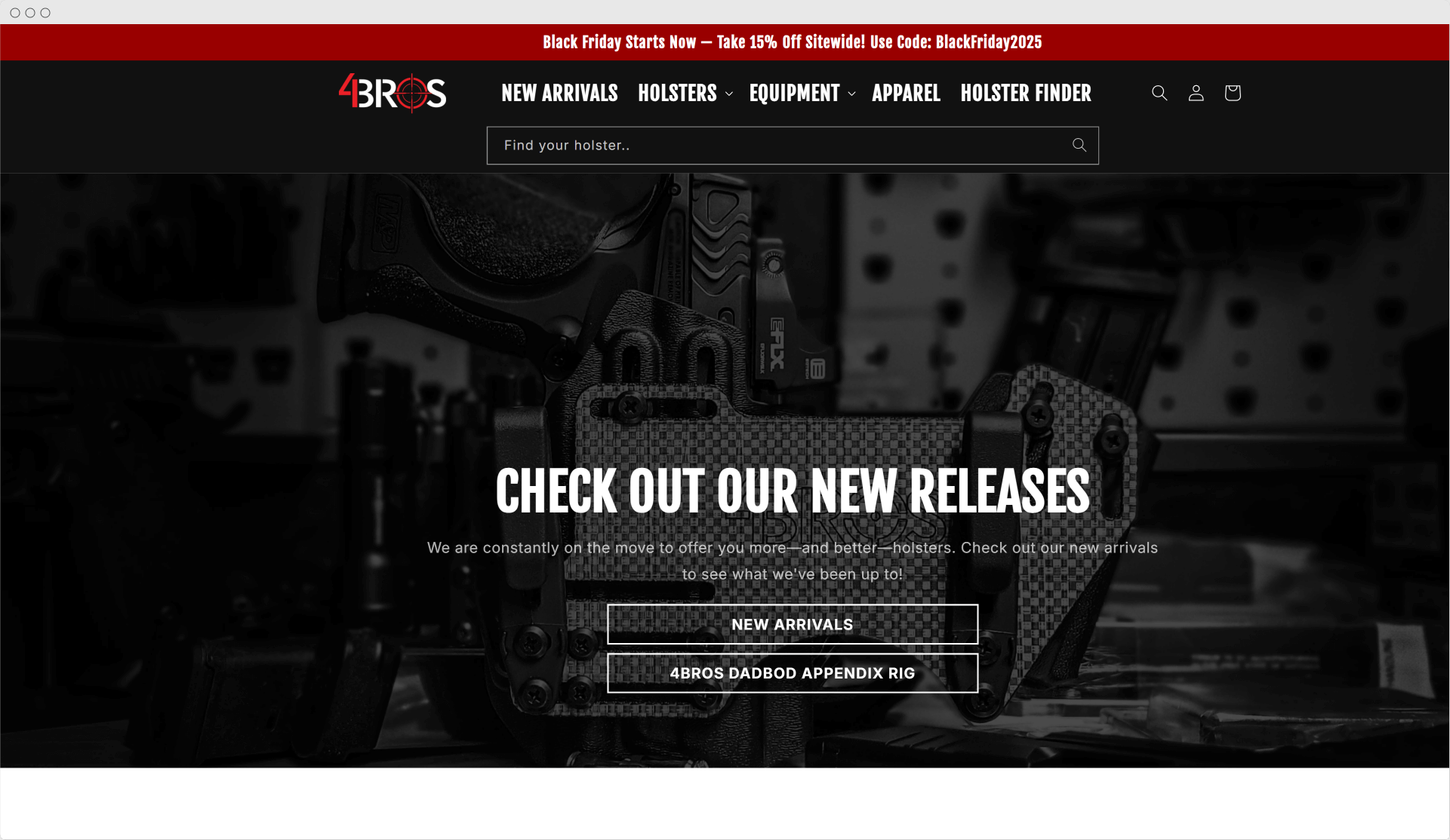
A custom Shopify build for a tactical-gear maker whose old store was costing them sales — rebuilt from theme up around their actual customer behavior.
The Problem
A theme that didn't fit how their customers actually shop.
The previous storefront was a stock theme with bolt-on apps. Configurable products didn't render properly, mobile checkout dropped on payment selection, and the PDP buried the variants their customers cared about most. Every plugin update broke something else.
Slow load times and worse Core Web Vitals.
Hero LCP was over 4 seconds on mobile. The theme shipped two carousel libraries, four font weights nobody used, and inline styles fighting Liquid sections. Google was punishing the site in search; ad ROAS was getting hammered by bounce.
No clear path to add new product lines.
Their team wanted to launch new holster styles every quarter. Doing it inside the old theme meant copy-pasting page sections, juggling apps, and praying nothing broke. The CMS didn't match how they actually thought about their catalog.
What Was Built
Theme
A custom theme written in Liquid — no app sprawl, no parent theme.
We replaced the stock theme with a hand-built one developed against Shopify CLI and Dawn primitives. Every section is a real Liquid section the merchant can rearrange. Configurable holster products got a dedicated PDP with variant logic that mirrors the way the team writes order tickets internally.
App bloat went from nine to two — checkout reviews and a single shipping calculator. Everything else is native theme code, owned by the client.
Performance
Critical-path CSS, single-image hero, and a build that ships ~40% less JS.
We inlined critical styles, deferred non-essential scripts, and replaced both carousels with a single CSS-driven gallery. Hero LCP dropped from 4.1s to 1.4s on a throttled 4G connection. Total blocking time fell into the green across all PDP templates.
Catalog
Product templates designed around how holsters are actually configured.
Holster, color, retention, attachment, hand — all surfaced as visual swatches with real-time price + lead-time updates pulled from the Storefront API. The team can launch a new holster line by duplicating one metaobject and assigning images. No new pages, no new code.
Care
An ongoing care plan so the site keeps shipping after launch.
Monthly performance audits, theme version control, security monitoring, and a shared Notion runbook. New product launches get hands-on support. The client knows what's deploying, when, and why — no surprise invoices.
Outcome
-
−65%
Mobile LCP improvement, from 4.1s to 1.4s on throttled 4G.
-
+38%
Mobile add-to-cart rate in the first 90 days post-launch.
-
9 → 2
Third-party Shopify apps replaced with native theme code.
-
~3 days
Time to launch a new holster line — down from two weeks.
-
100/100
Lighthouse Best Practices and Accessibility on the PDP template.
-
Zero
Plugin-related bugs in the six months following relaunch.